How does acupuncture work?
Acupuncture mechanisms
By Christine Guirguis
With the July 2012 addition of acupuncturists to the federal register of health practitioners (AHPRA), it’s worth having a look at one of the most common questions asked by the general public: exactly how does acupuncture work?
This question can be answered in two ways: within the context of traditional Chinese medical theory or using modern science. Traditional Chinese Medical Theory has a logic that is consistent and easily understood, but uses unfamiliar abstract language encompassing qi, yin and yang, and meridians. Modern science is much less foreign to western ears, however, it only provides us with glimpses of how acupuncture may exert it’s therapeutic effects.
Local effects
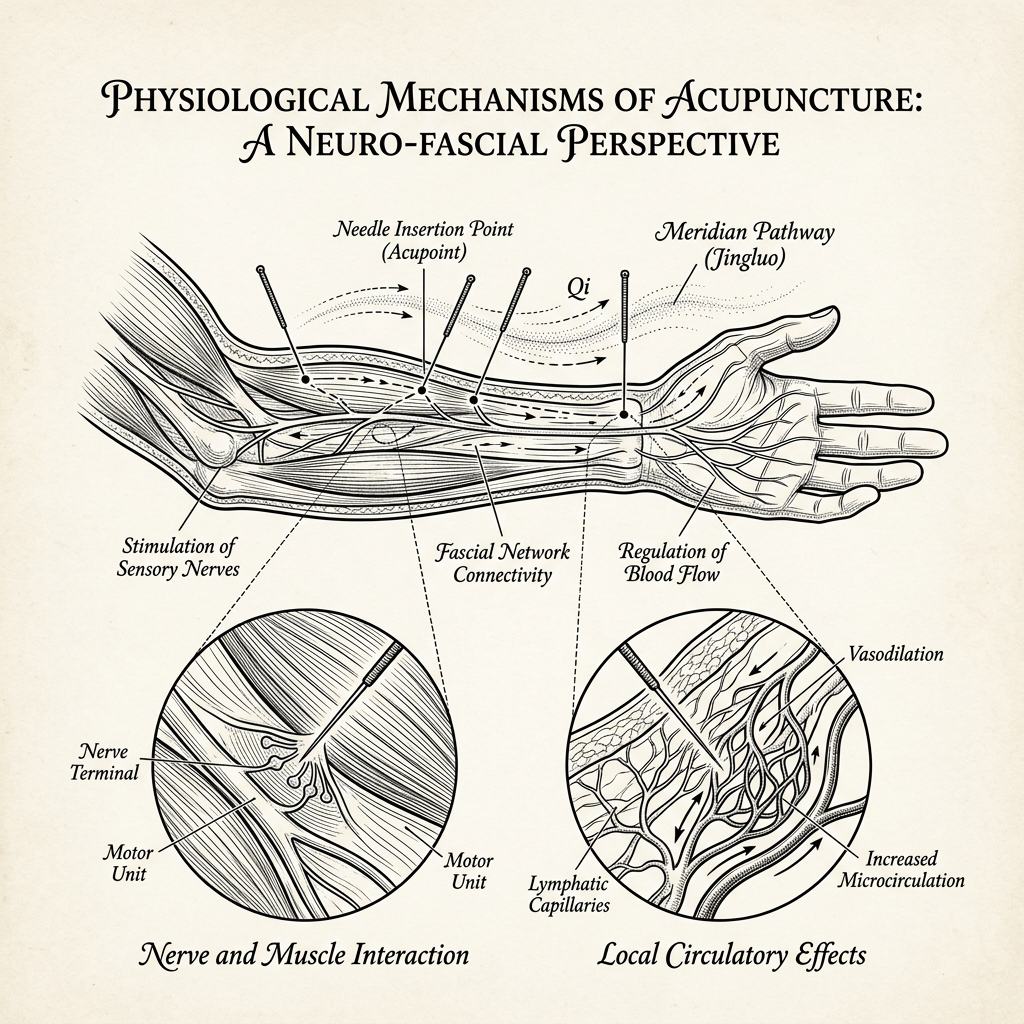
Acupuncturists often say that when an acupuncture point is needled, we are affecting something like electricity. We also describe that the needle feels like it has been ‘grasped’ when stimulated—that there is a sudden resistance to the movement of the needle. Our clients will often describe altered sensations of grasping, tingling or numbness during acupuncture.
These sensations may be explained by the effect that acupuncture has on connective tissue. Planes of connective tissue have been found to underlie many of the channel pathways. Needle rotation physically winds and distorts the connective tissue, and this distortion creates bioelectrical and biochemical signals (called mechanotransduction) which can regulate a wide range of cellular functions.1 Connective tissue has lower electrical resistance than that of the surrounding tissue, allowing electrical impulses to more easily flow through it.2 This could explain how acupuncture effects areas distal from the point being needled and exerts it’s more systemic effects.
Systemic effects
The immune system also seems to mediate the acupuncture effect and may provide an additional explanation acupuncture’s more systemic influences. After acupuncture, changes in the number of immune cells and the levels of immune chemical messengers have been observed.3 Interestingly, the immune cells mentioned in this study are found within the connective tissue and are stimulated by the connective tissue transduction.
Additionally, immune cells known as mast cells exist in greater numbers at acupuncture points. These mast cells degranulate (empty their chemical-containing granules) in response to acupuncture.4 Serotonin and histamine are amongst chemicals released when mast cells degranulate, and these are involved in functions as broad as allergic responses, immunity, inflammation and wound healing.
Effects mediated by the nervous system
Brain imaging has become an interesting tool of investigation in acupuncture research. Functional MRI (fMRI) research shows that:
Different areas of the brain are activated by acupuncture when compared to the needling of random points on the body.5,6
Different combinations of acupuncture points illicit different patterns of brain activity.7
Acupuncture affects the connectivity between different regions in the brain during and after treatment.8
Examples of studies using fMRI
Carpal Tunnel Syndrome. A study of acupuncture for the treatment of carpal tunnel syndrome found that of the regions in the brain representing the 2nd and 3rd fingers of those with carpal tunnel syndrome were seen to change to resemble normal subjects after a series of acupuncture sessions.8
Regulation of Heart Rate. Another interesting study revealed that whilst both the stimulation of an acupuncture point (PC-6) and a random point both decreased heart rate in human subjects, only the stimulation of the acupuncture point resulted in the increase in vagus nerve regulation of the heart.
–
These glimpses into how acupuncture may work from a biological perspective are interesting, but are far from complete, they do however begin to help us understand why acupuncture can be used in a broad range of conditions.
References
Langevin, H. M. et al. (2006). Subcutaneous tissue fibroblast cytoskeletal remodeling induced by acupuncture: evidence for a mechanotransduction-based mechanism. Journal of Cellular Physiology, 207, 767-774.
Langevin, H. M. & Yandow, J. A. (2002). Relationship of acupuncture points and meridians to connective tissue planes. The Anatomical Record (New Anat.), 269, 257-265.
Joos, S. et al. (2000). Immunomodulatory effects of acupuncture in the treatment of allergic asthma: a randomized controlled study. Journal of Alternative and Complementary Medicine, 6, 519-525.
Zhang, D. et al. (2008). Role of mast cells in acupuncture effect: a pilot study. Explore (NY), 4, 170-177.
Fang, J. L. (2004). Functional MRI in healthy subjects during acupuncture: different effects of needle rotation in real and false acupoints. Neuroradiology, 46, 359-362.
Yoo, S. S. et al (2004) Modulation of cerebellar activities by acupuncture stimulation: evidence from fMRI study. Neuroimage, 22, 932-40.
Zhang, W. T. (2004) Evidence from brain imaging with fMRI supporting functional specificty of acupoints in humans. Neuroscience Letters, 354, 50-53.
Napadow, V. (2006) Hypothalamus and amygdala response to acupuncture stimuli in carpal tunnel syndrome. Pain, 130, 254-66.